
Choosing a Gas Detector Calibration Laboratory: Why ISO/IEC 17025 and ILAC-MRA Are Non-Negotiable
In the high-stakes world of industrial safety—spanning from the petrochemical plants of Asaluyeh to the burgeoning oil fields of Basra—the margin for error is zero. When a technician enters a confined space, they aren’t just carrying a gas detector; they are carrying a promise that they will return home safely. However, that promise is only as reliable as the last calibration performed on that device.
For HSE managers and procurement officers, selecting a Gas Detector Calibration Laboratory is a decision that carries legal, financial, and moral weight. In this comprehensive guide, we will explore why ISO/IEC 17025 accreditation and the ILAC-MRA mark are the global benchmarks for safety, and how they bridge the gap between “working” equipment and “accurate” equipment.
1. The Anatomy of Calibration: More Than Just a “Zero” Adjustment
Many in the industry mistakenly believe that calibration is a simple procedure of “zeroing” the sensor in fresh air. In reality, industrial environments subject sensors to “poisoning,” drift, and physical degradation.
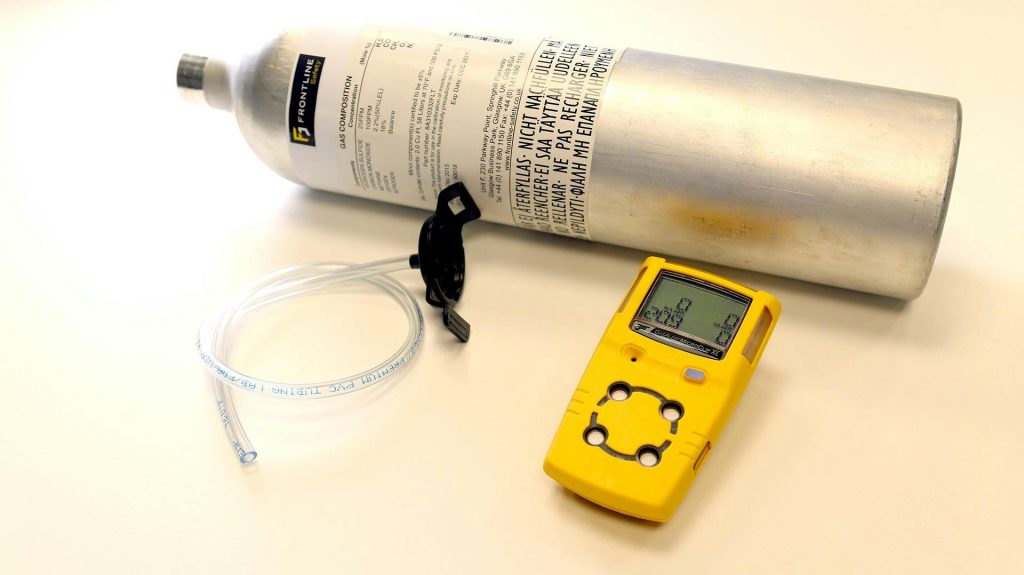
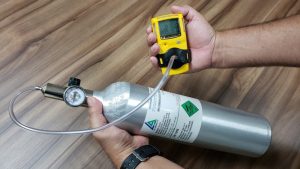
A professional calibration involves challenging the sensor with a known concentration of Certified Reference Material (CRM). This process ensures that the detector’s response curve is linear and that its alarm setpoints trigger exactly when they should. Without the rigorous oversight of a quality management system like ISO 17025, there is no guarantee that the gas used for testing hasn’t expired or that the technician followed the correct flow-rate protocol.
2. Why ISO/IEC 17025 is the “Gold Standard” for HSE
While ISO 9001 focuses on general business management, ISO/IEC 17025 is specifically designed for testing and calibration laboratories. It doesn’t just ask, “Do you have a process?” It asks, “Are you technically competent to produce accurate results?”
Key Requirements of ISO 17025:
-
Traceability: Every measurement must be traceable to the International System of Units (SI). If your lab calibrates a H2S sensor, they must prove that their reference gas is linked back to a national metrology institute.
-
Method Validation: Labs cannot just “wing it.” They must use validated, standard operating procedures (SOPs) that minimize variance.
-
Personnel Competence: Under this standard, technicians must undergo regular proficiency testing. This is vital in preventing the “human errors” that often plague the calibration industry.
3. The ILAC-MRA Edge: A Passport for Global Recognition
For companies like Imen Kia Sanat (IKS), looking to serve cross-border markets such as Iraq, the ILAC-MRA (International Laboratory Accreditation Cooperation) mark is the ultimate differentiator.
What does ILAC-MRA mean for your business?
The ILAC Mutual Recognition Arrangement (MRA) ensures that a calibration certificate issued in Iran by an accredited lab is technically equivalent to one issued in Germany, the UK, or the USA.
-
Elimination of Re-Testing: If you are a contractor working for an international oil major (like BP, Shell, or Lukoil) in Iraq, they will demand certificates that meet international standards. An ILAC-accredited certificate is accepted globally, saving you the cost and time of local re-validation.
-
Legal Protection: In the event of an industrial accident, having a certificate with the ILAC-MRA mark provides a robust legal defense, proving that you exercised “due diligence” by using a globally recognized laboratory.
4. Reducing Human and Technical Errors (The Research Perspective)
As a leader in the HSE field, our research at Imen Kia Sanat has shown that over 60% of gas detector failures are not due to sensor death, but to improper calibration techniques.
Technical Errors:
Common technical errors include using the wrong regulator (which can pressurize and damage the sensor) or failing to account for environmental cross-sensitivity. An ISO 17025 lab maintains controlled environments (temperature and humidity) to ensure the sensor’s baseline is stable.
Human Errors:
Human error—such as incorrect data entry, skipping the “bump test,” or failing to recognize a “slow-responding” sensor—is the leading cause of safety bypasses. By implementing a strict ISO 17025 management system, these errors are mitigated through automated data logging and double-blind verification processes. This is the core philosophy behind the IKS calibration unit.
5. Regional Challenges: Calibration in Extreme Climates (Iran & Iraq)
The Middle East presents unique challenges for gas detection. High ambient temperatures (often exceeding 50°C) and extreme humidity in areas like Basra or Khuzestan can cause rapid sensor drift.
A standard laboratory might not calibrate for these extremes. However, a specialized Gas Detector Calibration Laboratory understands that:
-
Electrochemical sensors (for CO, H2S, O2) dry out faster in heat.
-
Catalytic bead sensors (for LEL) can be “poisoned” by silicones or lead in industrial dust.
-
Calibration Frequency must be adjusted based on the harshness of the environment, not just the manufacturer’s 6-month suggestion.
6. Comprehensive Services: From Dräger to Honeywell
A truly competent lab doesn’t just specialize in one brand. At IKS, our expertise spans the global leaders of the industry:
-
Dräger (Pac and X-am series): Precision calibration for high-end German engineering.
-
MSA (Altair series): Focusing on the XCell sensor technology.
-
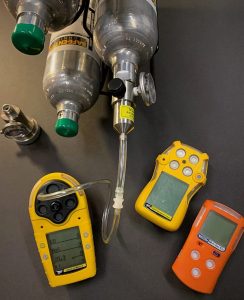
Honeywell (BW Technologies): Ensuring the reliability of the world’s most popular portable detectors.
-
Crowcon and Riken Keiki: Specializing in fixed gas detection systems for refineries.
7. How to Choose the Right Lab? A 5-Point Checklist for HSE Managers
When auditing your next calibration provider, ask the following:
-
Do you hold ISO/IEC 17025 accreditation for the specific gas types I need? (Don’t just accept a general ISO 9001 certificate).
-
Is your lab a signatory to the ILAC-MRA? (Crucial for international projects).
-
What is the uncertainty of measurement (MU) reported on your certificates? (A lab that doesn’t calculate MU isn’t following metrological standards).
-
Do you provide repair and sensor replacement using OEM parts?
-
Can you provide training for my staff on how to interpret calibration results?
8. Technical Deep-Dive: Calibration Excellence for Leading Brands
To provide the best Gas Detector Calibration Services, a laboratory must understand the unique sensor architecture of different manufacturers. At Imen Kia Sanat (IKS), we don’t use a “one-size-fits-all” approach.
A. Dräger Gas Detectors (Germany)
The Dräger Pac® 6500, 8000 and the multi-gas X-am® 2500/5000 series are known for their robust XXS sensors.
-
Our Expertise: We calibrate Dräger devices using original CC-Vision software and premium test gases. We focus on the “cross-sensitivity” of Dräger sensors to ensure that an H2S sensor isn’t giving false readings in the presence of high CO levels—a common issue in refinery stacks.
B. MSA Safety (USA)
The MSA Altair® 4XR and 5X are the workhorses of the mining and oil industries.
-
Our Expertise: These devices use XCell® Sensors. Our calibration protocols account for the rapid response time of these sensors. We ensure that the “End-of-Sensor-Life” indicator is correctly calibrated, so you are never caught off guard by a failing sensor in the field.
C. Honeywell & BW Technologies (Canada/USA)
From the GasAlertMicroClip XL to the high-end BW Ultra, these are the most common portable units in the Middle East.
-
Our Expertise: We specialize in calibrating the O2 and LEL sensors for BW units, which are prone to “drifting” in high-humidity environments like Basra and the Persian Gulf.
D. Crowcon and Riken Keiki
For fixed systems like the Crowcon Xgard or Riken Keiki SD-1, our technicians provide on-site calibration services, ensuring that the central control panel and the remote heads are perfectly synchronized.
9. Unbeatable Pricing and Premium Service: The IKS Promise
We understand that for large-scale projects in Iraq, Afghanistan, and the UAE, budget efficiency is just as important as safety. This is where Imen Kia Sanat redefines the market.
Why our prices are “Unbelievable”:
-
Direct Resource Access: Based in the industrial hub of Shiraz, we have optimized our supply chain for calibration gases and OEM spare parts, allowing us to pass those savings directly to you.
-
Bulk Calibration Discounts: Whether you have 10 or 1000 units, our “Economy-of-Scale” pricing model ensures that your HSE budget goes further without compromising on the ISO 17025 quality.
-
Fast Turnaround: We know that “Time is Money.” Our lab offers a 48-hour turnaround time for standard calibrations, ensuring your fleet is back in the field immediately.
Conclusion: Investing in Accuracy, Not Just Compliance
Calibration is often seen as a “check-box” exercise for auditors. But at its core, it is about the preservation of life. Choosing an ISO/IEC 17025 and ILAC-MRA accredited laboratory like Imen Kia Sanat ensures that your safety equipment is not just “compliant,” but “functional.”
By bridging the gap between Iranian expertise and international standards, we provide the oil, gas, and mining sectors in the region with the confidence to operate in the world’s most dangerous environments.
Ready to Secure Your Site? Contact Us Today!
Don’t leave your workers’ lives to chance. Partner with a laboratory that combines Doctorate-level HSE expertise with international ILAC-MRA standards.
Whether you are looking for a one-time calibration or a long-term service contract for a major oil field, we are ready to provide you with a quote that will exceed your expectations in both quality and cost.
Get Your Unbeatable Quote Now:
-
📧 Email Us: Send your equipment list and requirements to info@iks.co.ir or pourianaderi@gmail.com for a formal proposal within 24 hours.
-
💬 WhatsApp Support: For immediate consultation and fast pricing, message our international sales team directly on WhatsApp: +98 912 957 3568.
-
🌐 Visit Us: Explore our full range of HSE and Laboratory services at calibration.iks.co.ir.
Imen Kia Sanat (IKS): Where Global Standards Meet Local Expertise.